
The Complete Guide to Reusing Disposable Plastic Cutlery
A dishwasher tipped an entire rack of forks into the bin last month. Every tine was bent. Half the handles had gone chalky. The owner watched and said nothing, because someone had told him plastic cutlery washes fine.
It does wash fine. Just not the plastic he bought. That distinction is where most reuse plans quietly collapse, usually around week six, long before anyone opens a spec sheet. So this is not a piece about why reuse matters. It is about whether the SKU in your storeroom survives a commercial machine, what that machine actually demands, and where the legal line sits. Four questions. No preamble.
Start with the resin, not the invoice
Five families end up in foodservice: polypropylene, polystyrene, mineral-filled PP, PLA and its crystallised cousin CPLA, bamboo or birch. Under heat and alkali they behave like five unrelated materials. Price per thousand tells you almost nothing about which one you have.
You can settle most of it in half a minute. Bend a tine, let go. Pure PP flexes and springs back with a dull sound. PS cracks sharply and stays bent. Then drop a sample into water at 90°C and wait two minutes. PP softens a little and recovers. PS goes rubbery. CPLA starts to slump before the timer runs out. Anything failing that test is not a reuse candidate, whatever the carton claimed. Plenty of ranges bought from a custom PLA cutlery manufacturer that markets "durable" as a feel rather than a grade will fail it. Assume yours does until someone proves otherwise.
What the machine really does to a fork 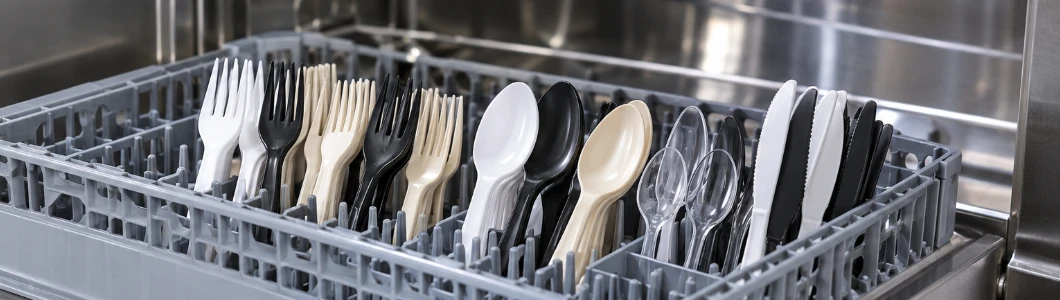 Commercial racks run at 65°C and above, two minutes contact, detergent around pH 11, water hitting the piece from several angles. Each of those attacks something different. Heat distorts. Alkali eats surface chemistry. Impingement works on geometry, and thin tine roots are where it wins.
Machine builders publish ware lists. PP, POM, melamine-formaldehyde, SAN and PCT are generally acceptable. Polystyrene is excluded, full stop. That one exclusion disqualifies a large slice of the value-pack cutlery sold across Europe, and it explains the phone calls about forks going soft in month two. When you source, ask an OEM cutlery factory for the heat deflection temperature of the exact grade, plus their position on machine washing in writing. "Food grade" is not an answer to that question.
Clean is not the same as sound
A fork can come out hygienically clean and still be a problem. Washing opens micro-scratches across the tines and around the handle underside. Those scratches hold water, pigment and smell. Tomato sauce leaves a permanent shadow. Coffee does the same thing to a cream handle. Scratched surfaces also dry slowly, so cutlery stacked damp stays damp for hours and the piece underneath never properly dries at all.
Retire on criteria instead of appearance. Pull a piece when the surface fuzzes under a fingernail, when a water film stops breaking and sits continuous across the tines, when a smell survives the wash, or when the same point snaps at plainly lower force than a new one. This is where most operations lose the argument, by treating a hygiene failure as cosmetic wear. A reusable plastic cutlery supplier who is worth the relationship will hand you a written retirement threshold. A trader will change the subject.
Reusable is a legal status
Here is the part people skip. Under EU Directive 2019/904, an item counts as single-use if it is not designed to accomplish multiple trips during its life cycle. Washing a single-use fork does not make it reusable. It makes your compliance position unlicensed. Part B of that directive banned single-use cutlery from the market back in July 2021, and Regulation 2025/40 has applied since 12 August 2026 with its own reuse obligations and Annex V restrictions for foodservice operators.
Australia wants proof rather than adjectives. New South Wales expects reusable alternatives to show at least 780 wash cycles against BS EN 12875-1 before they can be supplied for that purpose. That is a laboratory method, not a badge. If your menu carries reuse claims, buy from a cutlery manufacturer certified to BS EN 12875-1 and keep the report where an inspector can find it. That document is the whole defence.
Run the sum before you run the trial
Cost per use has four parts. Price divided by verified cycles. Wash cost per cycle. Labour for handling and racking. Loss rate once items leave the building.
A working example. PP fork at €0.028, tested to 60 cycles in your own machine, lands near €0.00047 per use. Add water, energy, chemical and handling at about €0.011 per piece per cycle and you are at €0.0115. A single-use wooden fork at €0.045 per unit is now the expensive choice per meal served. Change the cycle count to 15, which is what you get with the wrong resin, and the reusable fork reaches €0.0128 before labour, plus a replacement rate that never stops. Buyers working through bulk cutlery procurement for restaurant groups routes often get the unit price they wanted and skip the cycle test that would have justified it.
Three things that stall reuse in practice
Capacity first. Cutlery competes with plates and pans for rack space, and plastic dries slower than ceramic. You need ventilated shelving or a drying tunnel, not a shallow tray by the pass.
Takeaway volume second, and this is the one that kills projects. Reusable cutlery sent out with delivery does not come back. Past roughly 30 percent off-premise, replacements eat the whole saving, and no discount at the buying stage repairs it.
Cross-contamination third, usually as a layout mistake. Dirty and clean streams should not cross, and cutlery needs its own rack position where it is not buried under gastronorm pans. If a private label cutlery program is on the table, design the piece for washing before you design it for printing. Full-coverage print will not last 780 cycles.
Match the decision to your service format
Full-service rooms with a machine, decent turnover and low delivery volume can wash PP cutlery at a profit, and probably should. Delivery-led concepts should not start. The loss rate turns the model negative every time regardless of what the fork costs. Central kitchens sit between those two and need the transport leg costed honestly, because dirty cutlery travelling back is freight you pay for twice.
Stuck in the middle and needing an answer this quarter? Speak to a food-service cutlery wholesaler who stocks both paths, single-use and reuse-rated, so the decision stays commercial instead of turning into a philosophy seminar.
Write the specification into the order
Name the resin grade and the heat deflection temperature. Verified cycles, with the standard cited. Surface rules: no hollow handles, no deep grooves, no blind crevices, stackable with air gaps. Weight tolerance per batch. Traceability by lot. Then confirm tooling, because a cutlery OEM for central kitchens will move wall thickness and gate position for wash life and will say which mould changes buy you more cycles. Get the cycle test run on the cavity you are ordering, not on a family report.
Something you can do before Friday
Take ten pieces out of stock. Put them through fifty cycles in your own machine and weigh and flex them every ten. By Friday you will know whether reuse is a plan or a story. It costs one rack of dishwasher space and it answers the question no supplier conversation ever will.