
Fresh Tray Leakage Remediation Guide Five On-Site Actions That Cut Rework and Shrink
Five On-Site Actions That Cut Rework and Shrink
Field notes for packing and fresh-counter teams working with PP meat trays.
A night-shift supervisor pulls a row of chilled trays from the back of the shelf and finds three with a dark seam of purge along the base. They are not the three that were packed badly. They are the three that sat at the bottom of the stack. By morning the shelf has been reworked, the cases have been written off, and the operator who sealed them is being asked why the film failed.
This is the shape almost every leakage problem takes. It is discovered at the shelf, but it is created somewhere between the fill and the casing, and the team investigating it is usually looking in the wrong place - at the film, rather than at the two seconds before the film touched the rim.
What follows is the working sequence we run through with packing teams, in the order the failures actually occur.
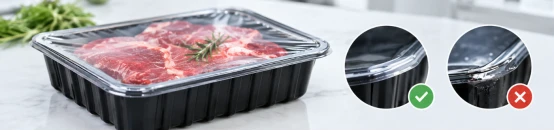
First, put a number on it
Leakage complaints tend to stay anecdotal because rework and shrink live in different reports. Before changing anything, pull four things for the same period: trays repacked per shift, the labour hours those repacks consume, kilos written off or marked down, and leakage-related returns from stores.
Two figures matter more than the rest. Rework cost is repacks multiplied by loaded labour rate. Shrink cost is written-off kilos multiplied by unit cost. For a line packing 2,000 trays a day, a rework rate of 1.2% is 24 trays, or roughly two operator-hours, every day - a number that rarely appears in anyone's report but appears every day of the year.
Then walk the line once with three people: the operator who seals, the one who cases, and the one who receives at the store. Ask each where they think the leaks start. The answers will differ, and the disagreement is the useful part.
Locate the failure before choosing an action
Leakage does not happen everywhere evenly. Map the route - fill, seal, case, transport, back-of-store, shelf, customer - and score each stage by its share of your complaints and repacks. In most operations, two stages carry the bulk of it. Those two decide the actions you keep.
|
Stage |
What fails |
What to look at |
|
Fill |
Purge or fat on the rim before sealing |
The rim, thirty seconds before the film goes on |
|
Seal |
Incomplete bond, lifting edge |
Peel test - does the film take tray fibres or nothing? |
|
Tray |
Wall bulging under load, base flexing |
Side profile of a full stack, after an hour |
|
Transport |
Liquid reaching the film from inside |
Ride one delivery, note the steepest angle |
|
Back-of-store |
Condensation pooling at the rim |
Temperature at the door-to-shelf transition |
|
Shelf |
Compression and customer handling |
Lane spacing, stack height, how staff grip the pack |
The right five actions cover the two heaviest stages and the two stages either side of them. If a stage scores high but can only be fixed by changing tooling or film specification, it does not belong in a guide to on-site actions - remove it and say so.

Action 1 - Make the rim check non-negotiable
What you see. Sealed trays that peel cleanly and show no fibre lift, failing within hours of casing. The film looks intact. The seal was never there.
Why. Fat or purge on the rim flat stops the film from wetting the surface. A contaminated seal holds long enough to pass inspection and fails under load. This is the most common failure in the plant and the cheapest to fix.
What to do. Position the fill so that the operator's hand passes the rim on the way to the sealer. Wipe with a dry wipe, not a wet one - a wet wipe leaves a film of its own. Build the check into the motion of sealing rather than making it a separate step, or it will be skipped at peak.
Verify. Peel ten trays at the start and end of each shift. Any seal that lifts without taking tray fibre is a contaminated rim.
Limits. This will not help if the die temperature or pressure is wrong. Rule that out first, or you will wipe a thousand rims and see nothing change.
Action 2 - Treat film, die and rim as one set
What you see. Edges lifting at the corners, film wrinkling at one point on the rim, or a seal that holds on three sides.
Why. The rim flat has a width. The die has a bearing surface. The film has a stiffness and a sealing window. When any two of the three are mismatched - a wide rim under a narrow die, a stiff film over a soft rim - the seal forms only where pressure lands.
What to do. Measure the rim flat, then the die face, and compare. Run one tray per setting across the sealing window, peel each, and mark the setting that leaves fibre across the full rim. Put a label on the machine with the current film, tray and setting, and update it when any of the three changes.
Verify. Re-run the peel series after every change of tray supplier or film roll.
Limits. Very narrow rims limit how much you can fix here. If the rim flat is materially narrower than the die, no setting will solve it.
Action 3 - Set a fill line, not a fill amount
What you see. Leaks concentrated in the trays that travelled furthest or sat at the bottom of the delivery stack, with liquid found under the film rather than leaking from a seam.
Why. Liquid reaches the seal from inside when the tray is tilted. A tray filled to the shoulder has nowhere for that movement to go except the rim, and once the seal band is wet from within, the failure is identical to contamination - with none of the warnings.
What to do. Mark a fill line in the tooling or on a gauge, and set it well below the sealing band - enough that a typical delivery tilt leaves the liquid below the rim. Enforce it with a scale check on a sample, not with instruction.
Verify. Take the heaviest-filled tray from a production run, tilt it to the steepest angle seen on the delivery route, hold fifteen seconds, and check for liquid at the rim.
Limits. If the menu requires higher fills for yield reasons, the tray format is wrong for that product. Move it to a deeper tray rather than lowering the line and losing margin.
Action 4 - Control the stack, not the tray
What you see. Deformation at the base corners of lower trays, walls bowing outward, and leaks appearing in cases that survived the line.
Why. Ribbed trays gain rigidity from geometry, not thickness. Once the base deflects, the wall bows and the rim distorts - and a distorted rim releases the film without tearing it.
What to do. Set a maximum stack height, measured in cases, and mark it on the pallet. Stretch-wrap the load so it resists shear rather than compressing it. Check the case fit: a case with spare room lets trays shift and leans the load.
Verify. Photograph a full stack in profile at load-out and again on arrival. Compare base corners.
Limits. Deep trays with heavy fill are limited by format. Above a certain load the answer is a stiffer format, not a stacking rule.
Action 5 - Fix the handover at the store
What you see. Returns from stores where the packing date and the shelf life do not match the condition of the product - no leak in transit, leak found at the counter.
Why. Back-of-store is where condensation forms on cold trays moved into warm air. Water sits on the rim and in the lap. Staff then grip packs by the film edge or stack them in lanes that compress the lower tray.
What to do. Agree a receiving check with the store - look at the base corners and the rim seal, not the film face. Mark lanes for stack height, and instruct staff to lift by the body, not the lid edge. This is the stage most often left out of the specification and most often the reason for a return.
Verify. Get one store to record leakage finds by cause for two weeks: transit, back-of-store, or shelf.
Limits. You do not control the store. This action depends on a partner willing to log what they find.
If you can only change one thing
Move the fill line down and enforce it with a scale. It costs nothing, takes one shift to introduce, removes the largest internal cause of seal failure, and reduces both rework and shrink at the same time. The other four actions are what keep that change from being reversed three weeks later.
What the guide will not solve
It will not fix a rim narrower than the sealing die, a film outside the machine's window, or a tray format carrying more weight than its geometry supports. Those are specification problems, and no amount of on-site discipline compensates for them. Knowing which category you are in is worth more than the five actions: teams that keep re-training operators usually have a specification fault they have not yet measured.
If you can answer these three questions after reading, the next step is a line walk, not a purchase order: which two stages carry 80% of your leaks, how many people and hours pass between a leak occurring and being found, and which single change would lower rework and shrink together?
Paper and Plastic Fresh Tray Selection Limits by Category
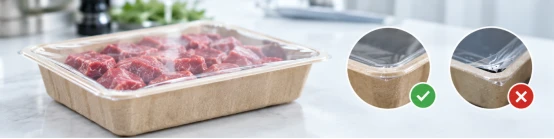
A customer of ours moved a chilled diced beef line from PP to a fibre tray. Sustainability commitment. It looked fine for two days. On the third, the base corners went soft, the lidding film lifted at one corner without tearing, and the batch came off shelf. Nothing was wrong with the meat. What killed the tray was roughly two tablespoons of purge sitting in the bottom since packing.
Nobody asked where the format would break. In tray selection that's the only question worth asking and it mostly doesn't get asked. People ask which material is better, which is greener, which is cheaper per unit. None of those can be answered before you know what the product does to the tray over its shelf life.
It isn't a material property
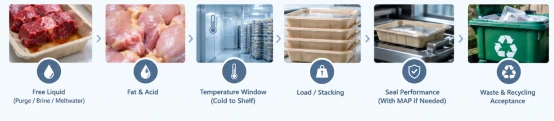
Six things decide whether a tray survives, and a product can break a format on any one of them. Free liquid, meaning purge, brine or meltwater, and how many days it sits there. Fat and acid, which go after coatings in a way water doesn't. The real temperature window, cold store to shelf included, not just the rating on the spec sheet. Load, which is how far the base deflects once a full stack has stood for an hour. Whether it seals on your machine at all, and holds a modified atmosphere if you need one. And what your waste contractor actually accepts, which is not the same question as what the tray is made of.
Whichever of those gives way first is the limit. The rest is marketing.
Raw meat, poultry, fish
Hardest group for paper. Purge collects, the base stays wet, fibre loses stiffness from the bottom up. Wet strength additives delay that, they don't prevent it. Once the base deflects the walls bow and the rim distorts, and a distorted rim lets the film go without tearing it, so it reads as a sealing fault when it's structural. Fish is worse than beef because of standing meltwater.
For red meat the decisive one is gas. High oxygen MAP holds the bloom and fibre can't hold MAP without a barrier layer. So the crossover is a spec, not a feeling: the moment shelf life or presentation needs MAP, plain fibre is out.
Watch the displaced cost too. Most fibre trays on a fresh counter are paper plus a PE or PP layer, and the performance comes from the layer. Your recycling claim now depends on a composite the receiving facility may not separate. A supplier who won't state coat weight isn't giving you a spec.
Produce, and where visibility counts
Produce breaks differently. Here the enemy is water in the air. Mushrooms, berries and whole fruit do better in something that doesn't trap moisture, and breathable fibre handles it. Plastic needs perforation or anti-fog, otherwise you get spoilage under a misted lid. Cut fruit and salad run the other way, and not for material reasons. Visibility is a real category requirement.
Heat, fat, freeze cycles
PP goes to roughly 120–130 °C. Fine for microwave, nowhere near an oven, which is where coated fibre wins. Something baked in the tray, chilled, then microwaved in store is asking for two windows at once. In practice that means changing format between production and retail rather than hunting for a cleverer tray.
Frozen fails on cycles, not temperature. An unlaminated fibre tray can delaminate after two thaw and refreeze rounds. Ask how many times the product crosses the freeze line before you ask for a price.
One shift is enough to test it
Fill to real net weight and leave it a day. Measure base deflection, photograph the rim at one, four and twenty-four hours. Tilt the heaviest tray to the steepest angle on your actual route and hold it fifteen seconds. Walk the cold store to shelf transition and see where condensation lands. Peel the film: if it comes away clean with no fibre or coating, it was never bonded. Soak a composite edge overnight and check whether the layers separate.
None of this picks a material for you. But if you're retraining operators to fix what looks like a sealing problem, you probably have a format limit you haven't measured.